
seo
Should Your Website Be in Spanish or Portuguese?
A second language helps when your customers want it and someone on your side can answer them in it. Here's how to tell, and how to build it right.
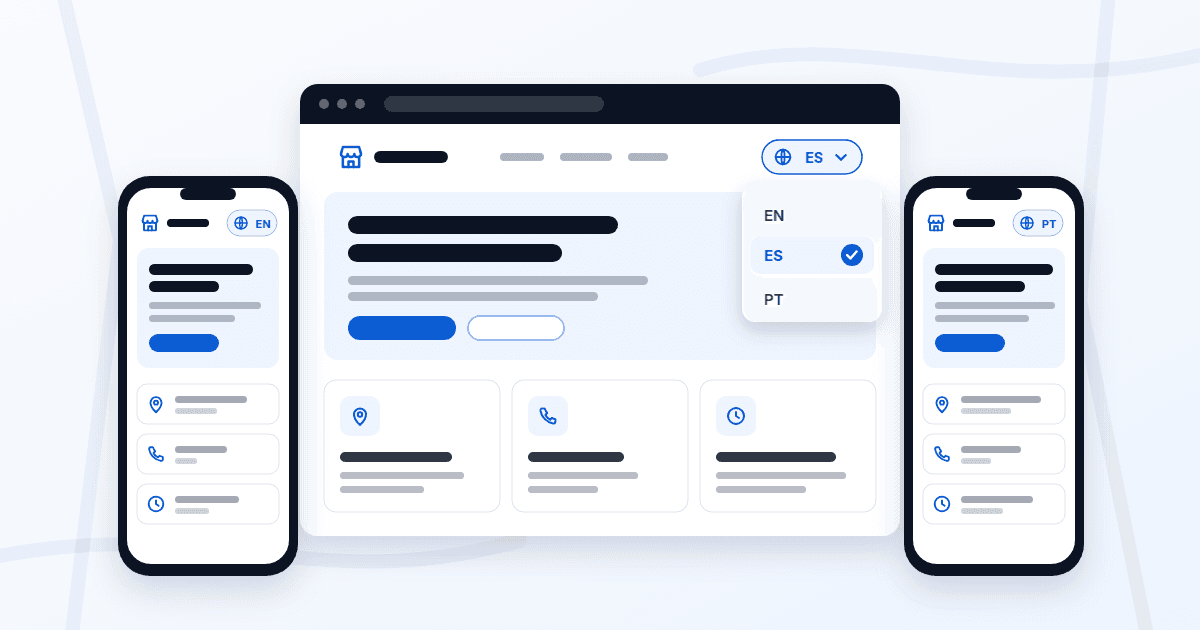
Short answer: yes, if a real part of your customers would rather read Spanish or Portuguese and someone on your side can answer them in that language. Build it as real pages with their own web addresses, written by someone who speaks the language. If nobody can reply to a call or a form in Spanish or Portuguese, fix that first.
When a second language makes sense
The U.S. Census Bureau reported that 67.8 million people in the United States spoke a language other than English at home in 2019, almost 1 in 5. Spanish was by far the most common of those languages. That's the national picture, from the Census story Nearly 68 Million People Spoke a Language Other Than English at Home in 2019.
Your town is a different question. The better evidence is already in your phone: the texts that arrive in Spanish, the customer who asks your crew something in Portuguese, the new customer who found you because someone mentioned you speak their language. Speaking another language at home doesn't mean someone can't read English. Plenty of people read both. Many still prefer to compare services and read the fine print in the language they think in.
A bilingual website is also ongoing work for a small business. Every change to the English page, a new service or new hours, has to reach the other language too. If you can't keep it as accurate as the English one, it's better to wait.
Write it for the reader, not for the translate button
Google's spam policies do mention translation, but in a narrow case. "Scaled content abuse" is when many pages are generated for the primary purpose of manipulating search rankings. Translation shows up in one of its examples: scraping feeds, search results or other content to generate many pages, including through "automated transformations like synonymizing, translating, or other obfuscation techniques," when those pages add little value for users. Translating your own pages for your own customers is a different situation.
A tool can give you a rough first draft. We'd have someone who speaks the language read it and fix it before it goes live, because a literal translation rarely sounds like your business. Words change from one country to another. A Spanish speaker might ask for a "presupuesto," a "cotización" or an "estimado" for the same quote. If your customers are Brazilian, write in Brazilian Portuguese, which reads differently from the Portuguese of Portugal. Use the words your customers actually say.
Keep the facts identical in every version: the same services, the same towns, the same hours. A translated page shouldn't promise anything the English one doesn't.
Set it up so Google shows the right version
Google's guide Managing multi-regional and multilingual sites is short, and most of it fits a small business.
Give each language its own address
Google recommends different URLs for each language version, rather than cookies or browser settings that swap the text on the same page. A folder such as yoursite.com/es/ is one of the options in Google's table, described as easy to set up with low maintenance. URL parameters like ?lang=es are marked "not recommended."
Tell Google which page is which
Link each page to its other language versions with hreflang annotations or a sitemap. Google explains the methods in Localized versions of your pages.
One language per page
Google says it determines a page's language from the visible content. It doesn't use the lang attribute or the URL for that. So keep the text and the menu of each page in one language, and avoid putting the English and Spanish side by side. Translating only the menu and buttons while the body stays in English doesn't make it a Spanish page.
The lang attribute still matters to people. The W3C's success criterion Language of Page explains that screen readers use it to load the right pronunciation rules. Set it on every version.
Let people choose
Google advises against redirecting visitors automatically based on the language you think they speak. Add a visible link to the other versions instead and let each person pick.
Keep the promise after the click
A Spanish page sets an expectation. If the contact form, the confirmation message and the person who calls back are English-only, the customer finds out at the worst moment. Either answer in that language or say plainly which parts happen in English.
This is how we approach it. Our own site runs in English, Spanish and Portuguese, and our Bilingual Plus plan includes your site in English plus Spanish or Portuguese. If your current site needs rebuilding first, that's our SEO website builds work, and lining the site up with your Google Business Profile is part of our local SEO. If your profile isn't set up yet, start with How to Show Up on Google Maps.
We won't tell you a second language guarantees more calls. Our FAQ says it plainly: we don't make up traffic promises.
FAQ
Is Google Translate good enough for my website?
As a first draft, it can help. The translation example in Google's spam policies is about scraping content to generate many pages, mainly to manipulate rankings. Translating your own site for your own customers isn't what that example describes. Our advice is still to have someone who speaks the language review it before you publish, because machine translation often misses the words your customers use.
Do I need a separate domain for the Spanish site?
No. A folder on your current domain, such as /es/ or /pt/, is one of the structures Google lists. Country domains like .mx or .br signal a specific country, which isn't what a U.S. business needs.
Do I have to translate every page?
Start with the pages your customers use most: home, main services and contact. Each translated page should be complete. Google warns that translating only the boilerplate while the main content stays in another language can create a bad experience.
Will a Spanish version make me rank higher?
Nobody can promise that. Google says Search tries to find pages that match the language of the searcher, so a Spanish page gives you a page to show for Spanish searches. Where it appears still depends on everything else Google weighs.
Sources
U.S. Census Bureau: Nearly 68 Million People Spoke a Language Other Than English at Home in 2019. Google Search Central: Managing multi-regional and multilingual sites, Localized versions of your pages and Spam policies for Google web search. W3C: Understanding Success Criterion 3.1.1: Language of Page. All checked October 24, 2026.
Find out if a second language fits your site
Ask for a free website and SEO audit and we'll tell you whether a Spanish or Portuguese version makes sense for you, and what to fix first. No card needed, and Rudy reviews it personally. Based in Massachusetts. We work with businesses anywhere.